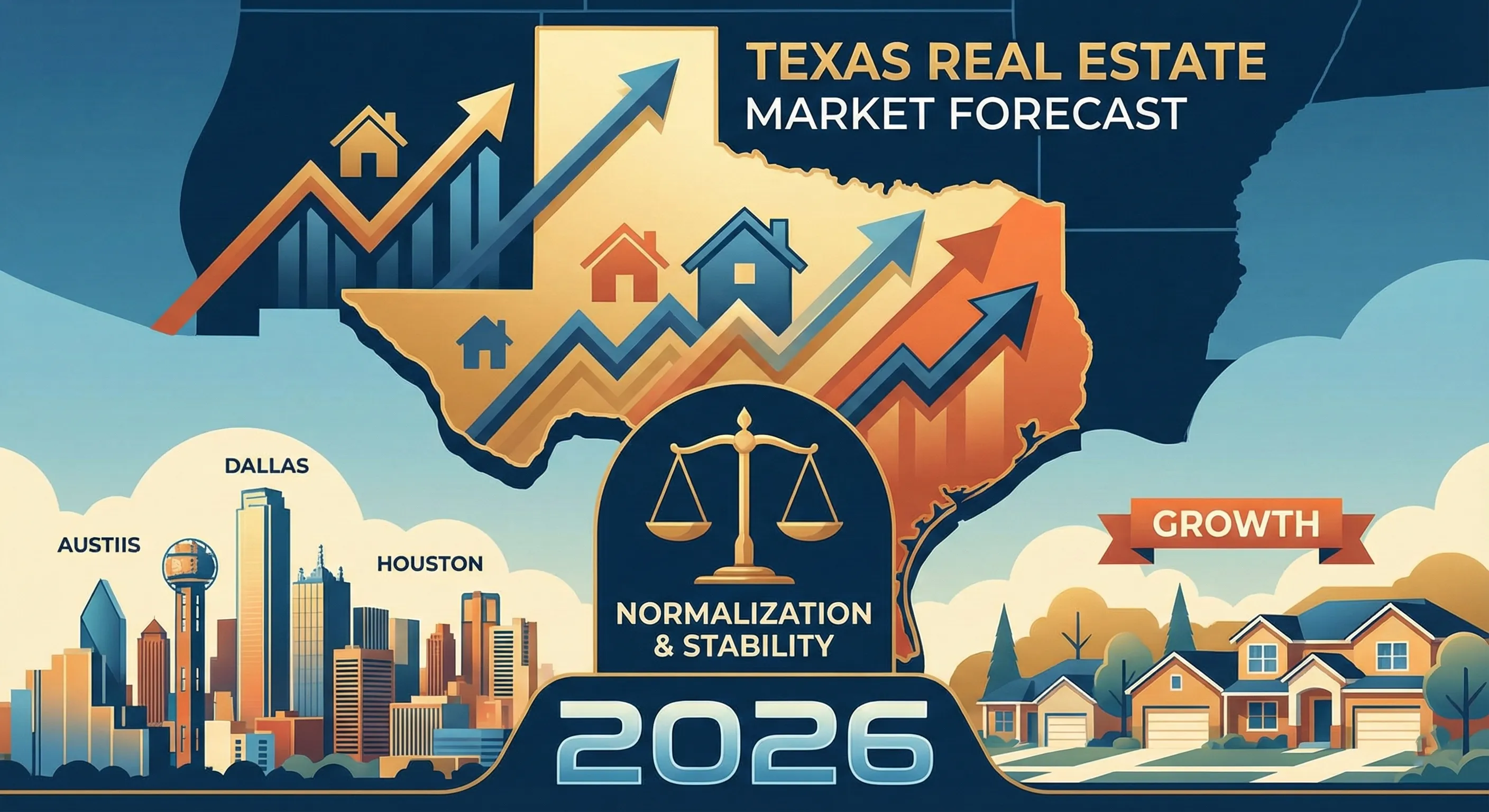
Texas Real Estate Market Forecast 2026: A Comprehensive Guide to the Great Housing Reset
The Texas real estate market forecast 2026 represents a defining moment for the Lone Star State as it navigates a transition from the frenetic cycles of the early 2020s toward a period of sustainable normalization. After the "shocks" of high interest rates and the subsequent cooling period observed throughout 2024 and 2025, 2026 is projected to be the year of the "Great Reset." For homeowners, buyers, and investors, this year will be less about surviving a crisis and more about strategic positioning within a market that is finding its new equilibrium. The underlying drivers of the Texas economy - massive corporate relocations, a growing population, and a resilient job market - remain the bedrock upon which this 2026 outlook is built.
As we move into the first quarter of the year, the Texas real estate market forecast 2026 suggests that the "lock-in effect," which prevented many homeowners from selling their properties due to ultra-low mortgage rates from previous years, will finally begin to thaw. While rates are not expected to return to the 3% levels seen during the pandemic, the stabilization of the 30-year fixed mortgage rate in a more predictable range will encourage a wave of move-up buyers and downsizers to list their homes. This increase in inventory will create a much healthier environment, moving the state closer to a balanced market where neither buyers nor sellers hold an overwhelming advantage.
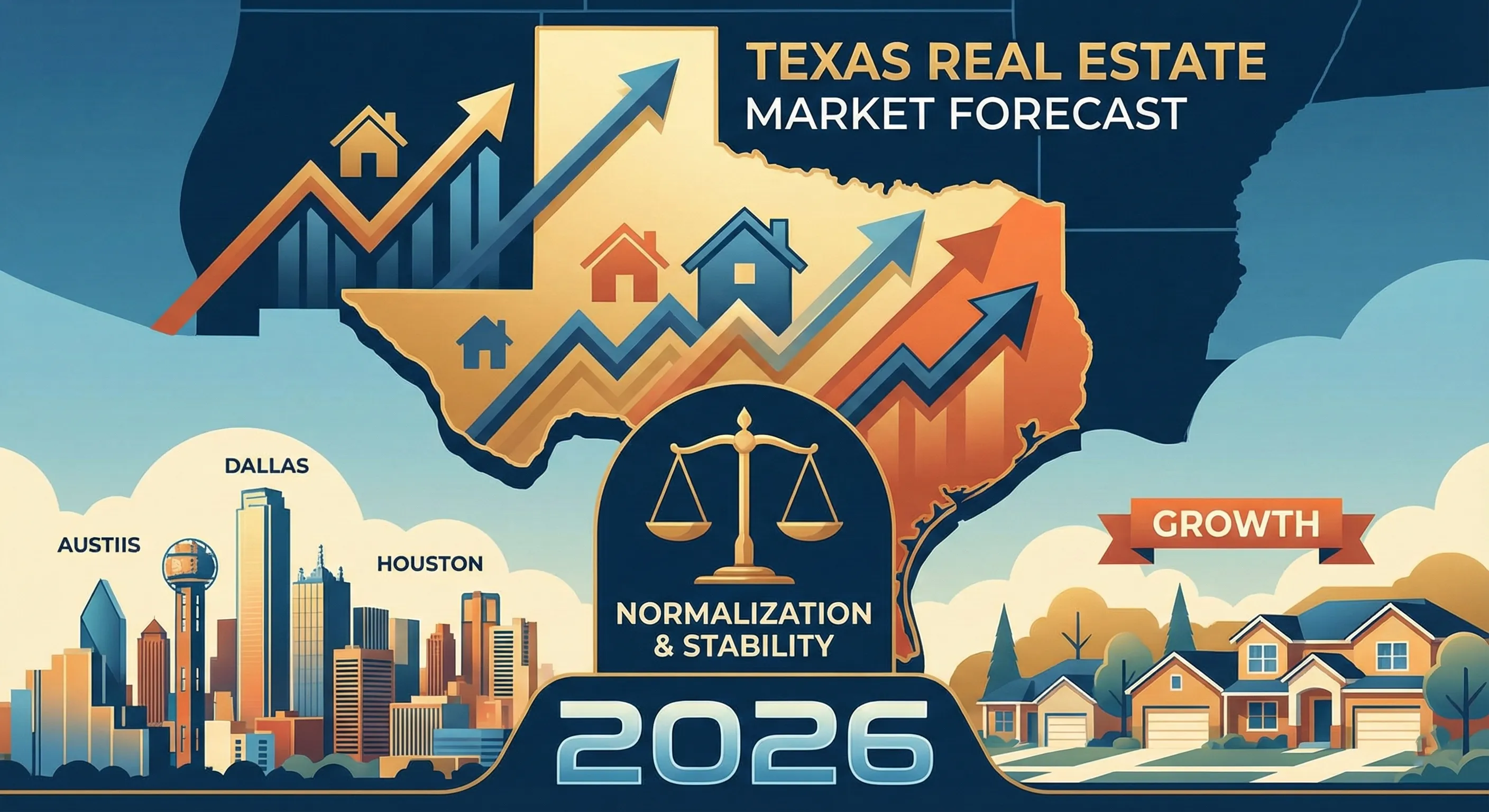
1. 2025 Retrospective: Setting the Stage for the 2026 Texas Market
To understand the Texas real estate market forecast 2026, one must first look at the corrective measures that defined the preceding year. 2025 was a year of "absorption," where the market grappled with the tail end of inflation and the plateauing of home prices in major metros like Austin and Dallas. During this period, the state saw a significant increase in the months of supply, which shifted from the extreme lows of 2022 to a more manageable 4.5 to 5 months by the end of 2025. This backdrop of cooling demand and rising supply set the stage for a 2026 that is focused on value and affordability rather than speculative growth.
The transition into 2026 also carries the weight of a transformed buyer sentiment. The "fear of missing out" (FOMO) that fueled the 2021-2022 boom has been replaced by a "wait and see" approach that is finally bearing fruit. As we enter the new year, the Texas real estate market forecast 2026 predicts that this pent-up demand will begin to release as buyers realize that the massive price drops some predicted are unlikely to materialize, while the cost of borrowing has reached a new, stable plateau. This creates a "goldilocks" scenario for the Texas market: not too hot to be unaffordable, but not too cold to be stagnant.
Key Factors Influencing the Market Shift
- Economic Diversification: Texas continues to move beyond energy into tech and aerospace.
- Population Inflow: Continued migration from the West Coast and Northeast remains a primary demand driver.
- Wage Growth: Local incomes are beginning to catch up with the increased cost of housing.
2. Mortgage Rate Predictions: The Impact of 5.9% to 6.4% on Borrowing
A central pillar of the Texas real estate market forecast 2026 is the stabilization of borrowing costs. Major financial institutions, including Fannie Mae and the National Association of Realtors (NAR), anticipate that the average mortgage rates will hover between 5.9% and 6.4% throughout much of 2026. While some optimistic forecasts suggest a dip below 6% by the fourth quarter, the consensus is that the days of extreme volatility are over. This predictability allows potential homeowners to calculate their long-term affordability with greater accuracy, reducing the "rate shock" that characterized the previous 24 months.
In 2026, the psychological impact of these rates cannot be understated. For many Texans, a rate in the high 5s or low 6s is the new "green light" for refinancing and purchasing. The Texas real estate market forecast 2026 indicates that as the spread between the 10-year Treasury yield and mortgage rates narrows, lenders will become more aggressive in offering mortgage incentives, such as temporary rate buydowns and reduced closing costs. This competitive lending environment will be a major catalyst for the projected 8% to 11% increase in existing-home sales across the state compared to the sluggish performance of 2024.
The Role of Refinancing in 2026
Homeowners who purchased properties at the 7% or 8% peaks of late 2023 and 2024 will likely look to refinancing as a primary financial move in 2026. This activity is expected to account for a larger share of mortgage originations, providing families with extra disposable income that often cycles back into the economy through home improvements and renovations.
3. Inventory Shifts: Balancing Supply and Demand in Early 2026
The Texas real estate market forecast 2026 highlights a significant achievement: the return to a "balanced market" in most major metropolitan areas. For the first time since the pandemic, inventory levels are expected to sustain a 5-to-6-month supply, which is historically considered the equilibrium point. This shift is particularly evident in the suburban markets surrounding the "Big Four" cities, where a combination of new construction completions and a rise in existing-home listings has given buyers more leverage than they have had in nearly a decade.
However, the Texas real estate market forecast 2026 warns that this inventory is not evenly distributed across all price points. While there is a relative abundance of luxury homes and mid-tier properties, the starter home segment continues to face shortages. First-time buyers in 2026 will still find themselves in competitive situations for well-priced homes under $350,000. To succeed in this environment, many buyers are turning toward condominiums and townhomes, which are seeing a surge in development as builders try to address the "missing middle" of the housing market.
4. Austin Real Estate: Navigating the Great Housing Reset
Austin remains the most discussed market in the Texas real estate market forecast 2026. After seeing some of the most dramatic price corrections in the country during 2024 and 2025, the Austin real estate market is finally finding its floor. Analysts at Redfin have dubbed this the "Great Housing Reset," where prices have retreated to a level that is more compatible with local salaries. By the second quarter of 2026, the median home price in Austin is expected to stabilize, ending the period of year-over-year declines and transitioning into a phase of modest, single-digit appreciation.
The Texas real estate market forecast 2026 for Austin also points to a shift in investor sentiment. The city's status as a global technology hub remains undisputed, with companies like Tesla and Samsung continuing to expand their footprint. This ensures a long-term demand for high-quality housing. For buyers, the 2026 Austin market offers something that was missing during the boom: time. With average days on market reaching 50 to 60 days, buyers can now conduct thorough home inspections and negotiate for seller concessions without the fear of being outbid within hours.
Austin's Emerging Neighborhoods in 2026
- Pflugerville and Manor: Areas seeing high growth due to tech corridor proximity.
- South Manchaca: A revitalization zone attracting younger professionals.
- Cedar Park: Remaining a top choice for families seeking high-quality public schools.
5. Dallas-Fort Worth: The Continuous Engine of Economic Growth
The Dallas-Fort Worth (DFW) metroplex is projected to be the strongest performing market in the Texas real estate market forecast 2026. Named as the No. 1 market to watch by the Urban Land Institute, DFW's sheer economic scale and job growth continue to propel housing demand. Unlike other regions that may see flat or slightly declining prices, DFW is expected to maintain a steady home price appreciation of 2% to 3% throughout 2026. This is largely due to the region's massive corporate relocation pipeline, which brings thousands of high-earning households into the area every month.
In the DFW housing market, the focus for 2026 is on the northern expansion. Cities like Frisco, Celina, and Prosper are seeing an unprecedented level of residential development, including sprawling master-planned communities that offer a "live-work-play" lifestyle. The Texas real estate market forecast 2026 suggests that while affordability remains a concern, the DFW area's relatively lower cost of living compared to coastal cities continues to make it an attractive destination. For sellers, the DFW market remains favorable, provided that properties are priced accurately according to the new "normalization" standards.
6. Houston’s Global Spotlight: Preparing for the 2026 FIFA World Cup
The Houston housing market is entering a unique phase in the Texas real estate market forecast 2026, driven by its role as a host for the 2026 FIFA World Cup. This global event is acting as a massive catalyst for infrastructure investment and urban revitalization. From the renovation of public transit systems to the beautification of the downtown core, the "World Cup effect" is expected to boost property values in central Houston. Investors are particularly focused on the short-term rental market, anticipating a surge in demand from international travelers during the summer of 2026.
Beyond the sporting spectacle, the Texas real estate market forecast 2026 for Houston remains anchored by the energy sector and the Texas Medical Center. These industries provide a bedrock of stability that few other cities can match. While the median home price in Houston is expected to rise by approximately 4%, the city remains one of the most affordable major metros in the United States. This value proposition is attracting a new wave of real estate investors who are moving their capital away from more volatile markets into Houston's reliable rental properties.
Impact of Global Visibility
The exposure from the World Cup is expected to attract more than just tourists; it is likely to pique the interest of international investors. The Texas real estate market forecast 2026 anticipates a rise in foreign direct investment in Houston's commercial real estate and high-end residential sectors, further diversifying the city's economic base.
7. San Antonio and Secondary Markets: The Search for Affordability
As prices in the larger metros stabilize at higher levels, the Texas real estate market forecast 2026 highlights San Antonio as the frontier for affordability. For many first-time homebuyers and young families, San Antonio represents the best opportunity to enter the market without a massive financial burden. While the city may see a slight market correction of -3.6% in some neighborhoods as part of a broader normalization, the overall outlook remains positive. The steady demand from the military and healthcare sectors ensures a consistent floor for home prices.
Secondary markets like El Paso, Corpus Christi, and Lubbock are also becoming key players in the Texas real estate market forecast 2026. These cities are seeing increased interest from "digital nomads" and retirees who are looking to maximize their purchasing power. The growth of the "I-35 corridor" between San Antonio and Austin is creating a new megaregion where the lines between the two cities are blurring. This development is driving significant land appreciation and new housing starts in towns like New Braunfels and San Marcos, which are no longer just "commuter towns" but destinations in their own right.
8. Investment Strategies: From Speculation to Income-Focused Yields
For the investment community, the Texas real estate market forecast 2026 signals a major shift in strategy. The era of "fix-and-flip" and rapid equity gains has transitioned into a "buy-and-hold" environment focused on cash flow and rental yields. With mortgage rates having stabilized, investors can now model their returns with greater precision. The demand for single-family rentals (SFR) is expected to remain high, particularly as a segment of the population chooses to rent by choice, seeking the amenities of a house without the long-term commitment of a mortgage.
Another growing trend in the Texas real estate market forecast 2026 is the Build-to-Rent (BTR) model. Institutional investors are partnering with homebuilders to create entire communities specifically designed for renters. These developments offer a high level of professional management and are proving to be extremely popular in the suburbs of Dallas and Houston. For the individual investor, the key to success in 2026 will be geographic diversification - moving beyond the saturated urban cores into the high-growth suburban rings where property taxes are lower and tenant demand is rising.
2026 Investment Priorities
- Yield over Appreciation: Focusing on monthly net income rather than speculative price growth.
- Professional Management: Utilizing technology to reduce vacancy rates and maintenance costs.
- Section 8 and Workforce Housing: Exploring government-backed rental programs for guaranteed income.
9. New Construction Trends: Solving the Housing Shortage in Late 2026
The Texas real estate market forecast 2026 places a heavy emphasis on the role of homebuilders. Texas continues to lead the nation in housing starts, and by late 2026, the delivery of these units will be crucial in preventing another price spike. To counteract high land and labor costs, builders are increasingly utilizing innovative construction techniques, such as modular housing and 3D printing. These methods are not only faster but also allow for a lower price per square foot, making new construction a viable alternative for budget-conscious buyers.
The Texas real estate market forecast 2026 also notes a change in new home features. Builders are moving away from massive "McMansions" in favor of more efficient, high-density designs. Features like "accessory dwelling units" (ADUs) and multi-generational floor plans are becoming standard, catering to the changing demographics of the Texas population. For buyers, the advantage of new construction in 2026 is the ability to customize finishes and take advantage of energy-efficient technology, which can significantly reduce long-term utility costs and insurance premiums.
The Future of Smart Homes
In 2026, the integration of smart home technology is no longer a luxury but a standard expectation. From AI-driven climate control to integrated EV charging stations, the Texas real estate market forecast 2026 suggests that homes that prioritize "sustainability" and "connectivity" will hold their value better than older, non-upgraded inventory.
10. Q4 2026 and Beyond: Predicting the 2027 Transition
As we look toward the final months of the year, the Texas real estate market forecast 2026 suggests a market that has finally "found its feet." The turbulence of the mid-2020s will be a memory, replaced by a cycle of steady growth and rational pricing. Economists predict that the fourth quarter of 2026 will see a surge in market activity as the final wave of hesitant buyers enters the market, buoyed by the stability of the previous 12 months. This momentum is expected to carry directly into 2027, which many believe will be a "boom year" for existing-home sales.
The long-term outlook for the Texas housing market remains incredibly bullish. The state's commitment to "pro-growth" policies, coupled with its status as a top destination for both domestic and international migration, ensures that housing will remain a primary driver of wealth creation. While challenges like property taxes and climate-related insurance costs will continue to be part of the conversation, the 2026 forecast proves that the Texas market is resilient enough to adapt. For those who stayed the course during the uncertain times of 2024 and 2025, 2026 will be the year their patience pays off.
Conclusion: The Path Forward in the 2026 Texas Real Estate Market
The Texas real estate market forecast 2026 provides a clear roadmap for anyone looking to navigate one of the most dynamic property landscapes in the world. The overarching theme of "normalization" is a positive sign for the long-term health of the state, ensuring that the "Texas Dream" of homeownership remains within reach for a broad segment of the population. By focusing on fundamental value, keeping a close eye on mortgage rate fluctuations, and understanding the unique dynamics of each metro area, buyers and investors can make decisions with a high degree of confidence.
As the year progresses, the Texas real estate market forecast 2026 will likely be remembered as the year the "housing bubble" narrative was finally put to rest. Instead of a crash, Texas delivered a "soft landing" followed by a strategic reset. Whether you are looking at the tech-driven recovery of Austin, the corporate dominance of Dallas, the global visibility of Houston, or the affordable opportunities in San Antonio, the 2026 market offers a wealth of possibilities. The Lone Star State continues to prove that it is not just a place to live, but a place to build a future.