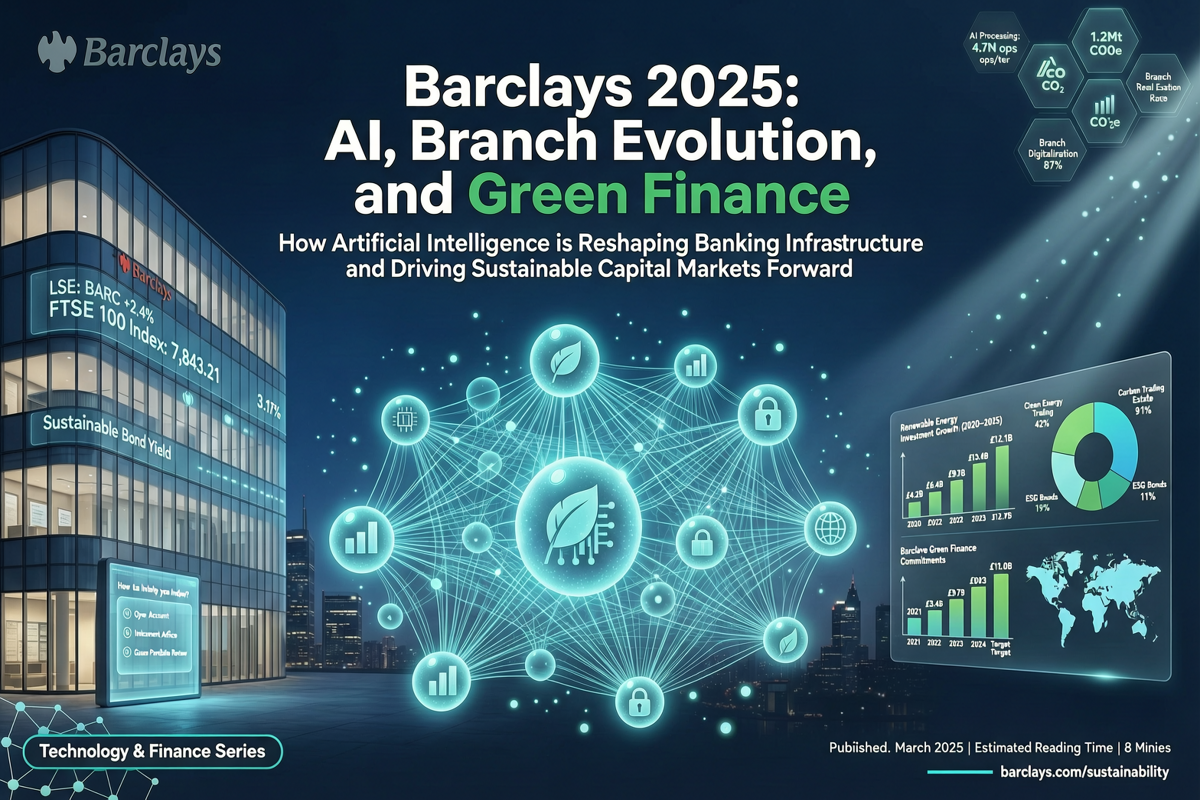
Barclays 2025: AI, Branch Evolution, and Green Finance
Explore Barclays' 2025 strategy: AI-driven banking, branch transformation, and sustainable finance leadership. What it means for customers and investors.
Barclays in 2025: Navigating a New Era of Banking
As one of the world's oldest and most recognized financial institutions, Barclays has been a cornerstone of global banking for over 330 years. In 2025, the bank is undergoing a profound transformation, driven by artificial intelligence, shifting customer expectations, and an unwavering commitment to sustainability. This article explores the key pillars of Barclays' strategy and what they mean for customers, investors, and the broader financial landscape.
AI and Personalization: The New Face of Customer Service
Barclays has long been a pioneer in digital banking, and 2025 sees the bank doubling down on artificial intelligence to enhance customer experiences. From AI-powered chatbots that handle complex queries to personalized financial advice generated by machine learning algorithms, Barclays is leveraging data to offer tailored solutions. The Barclays app now features an AI assistant that can analyze spending patterns, suggest budgeting strategies, and even predict future cash flow needs. This level of personalization is not just a convenience—it's a competitive necessity in an era where customers expect their bank to understand their unique financial lives.
Moreover, Barclays is using AI to detect fraud in real time, reducing false positives and improving security. The bank's investment in generative AI is also streamlining internal processes, from risk assessment to compliance monitoring, resulting in faster loan approvals and more efficient operations.
Branch Evolution: From Transaction Hubs to Advisory Centers
While digital is king, Barclays recognizes that physical branches still play a vital role, especially for complex financial decisions. In 2025, the bank's branch network is evolving into advisory centers, where customers can receive face-to-face guidance on mortgages, investments, and retirement planning. These branches are smaller, more technology-enabled, and staffed by specialists rather than cashiers. Barclays has also introduced 'pop-up' branches in underserved communities and partnered with local businesses to offer banking services, ensuring accessibility without the overhead of traditional branches.
The bank's 'Barclays Local' initiative now operates in over 200 locations across the UK, offering free financial education workshops and digital skills training. This community-focused approach not only builds trust but also helps bridge the digital divide, ensuring that no customer is left behind.
Green Finance: Leading the Charge to Net Zero
Sustainability is no longer a niche concern—it's a core business imperative. Barclays has set ambitious targets to achieve net-zero operational emissions by 2030 and to facilitate £100 billion of green financing by 2030. In 2025, the bank is a major player in the green bond market, financing renewable energy projects, sustainable infrastructure, and low-carbon technologies. Barclays also offers 'green mortgages' with preferential rates for energy-efficient homes, and its 'Green Home' scheme provides loans for solar panels and insulation.
Critically, Barclays is also helping its corporate clients transition to more sustainable business models. Its Sustainable Finance team works with companies across sectors to develop transition plans, measure carbon footprints, and access green capital markets. This proactive approach positions Barclays as a leader in the fight against climate change, while also opening new revenue streams.
Investment Banking: Capitalizing on Global Trends
Barclays' investment banking division remains a powerhouse, advising on mergers, acquisitions, and capital raising across the globe. In 2025, the bank is focusing on sectors poised for growth, including technology, healthcare, and energy transition. Its M&A advisory business has seen a surge in cross-border deals, particularly between European and Asian markets. Barclays is also expanding its presence in private credit, offering bespoke financing solutions to mid-market companies.
The bank's equities and fixed income trading desks are leveraging AI to improve pricing and risk management, while its research team provides clients with cutting-edge insights on macro trends and sector-specific opportunities. Despite intense competition, Barclays' investment bank continues to deliver strong returns, thanks to its deep expertise and client-first approach.
Challenges and Risks: Navigating Uncertainty
No transformation is without challenges. Barclays faces headwinds from rising interest rates, regulatory pressures, and the ongoing war for talent. The bank must also manage the risks associated with its ambitious climate goals, ensuring that its financing activities genuinely contribute to emissions reductions rather than just 'greenwashing'. Additionally, the rapid pace of technological change means Barclays must continuously invest in cybersecurity and data privacy to protect customer trust.
Another key challenge is maintaining profitability in a low-margin environment. While digital channels reduce costs, they also increase competition from fintechs and big tech firms. Barclays' strategy of combining digital efficiency with high-touch advisory services aims to differentiate it from both traditional rivals and new entrants.
What This Means for Customers
For everyday customers, Barclays in 2025 offers a more intuitive, secure, and personalized banking experience. The ability to manage finances via app, receive tailored advice, and access green products aligns with modern values and lifestyles. For businesses, Barclays provides a full suite of services, from working capital finance to sustainability consulting, helping them navigate an increasingly complex world.
Investors, meanwhile, are watching Barclays' progress closely. The bank's focus on efficiency, sustainability, and innovation is expected to drive long-term shareholder value, though short-term volatility remains a factor.
Conclusion: A Bank for the Future
Barclays' 2025 strategy reflects a clear vision: to be a digitally-led, customer-centric, and sustainable bank that earns the trust of its stakeholders. By embracing AI, reimagining branches, and leading on green finance, Barclays is not just adapting to change—it is shaping the future of banking. As the year unfolds, the bank's ability to execute on these priorities will determine its place in the next chapter of financial history.