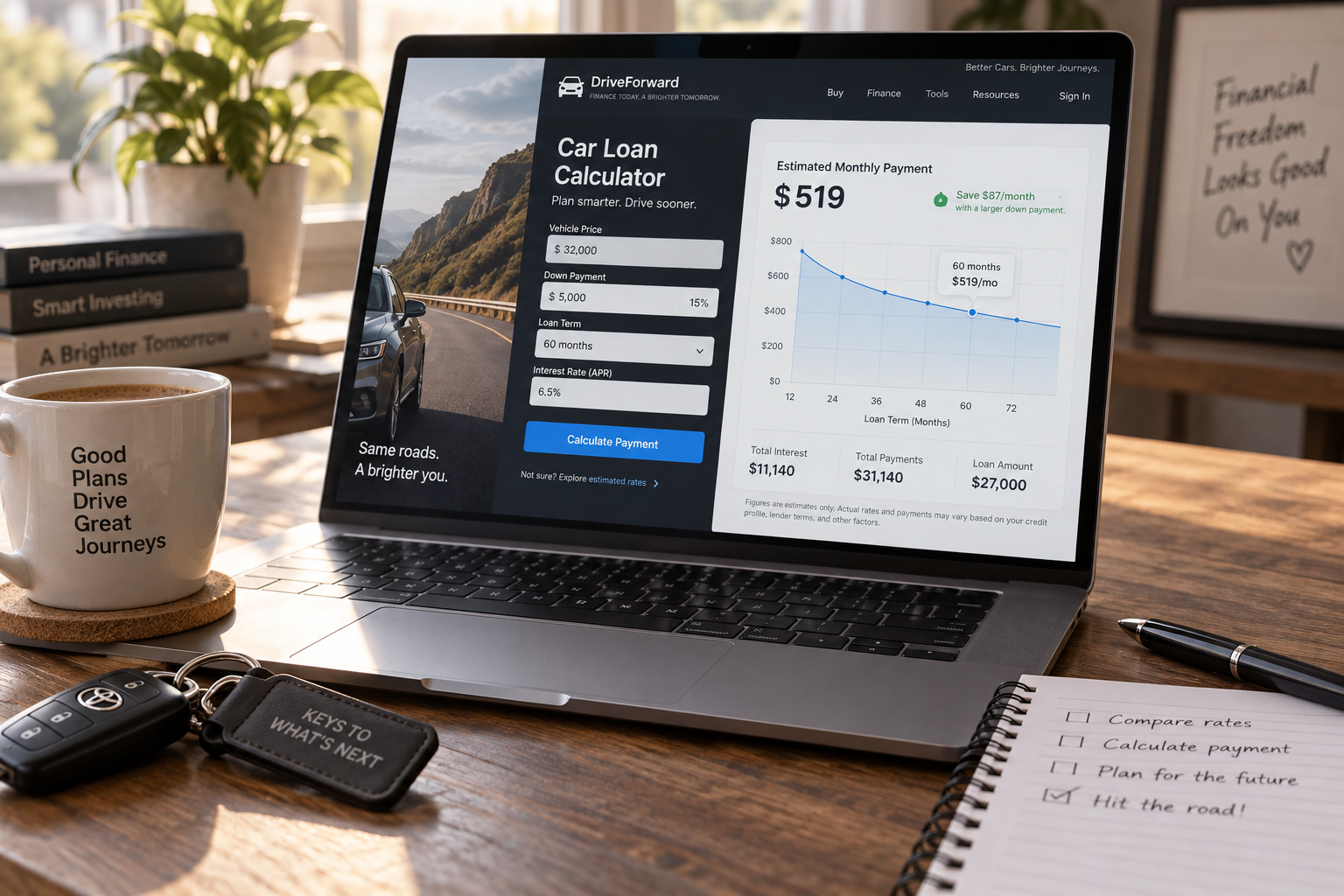
Car Loan Calculator: Decode Payments, Interest, and Total Cost
A car loan calculator does more than show a monthly payment. Learn how to use one to compare offers, spot hidden costs, and negotiate a better deal.
What a Car Loan Calculator Actually Does
A car loan calculator is more than a monthly payment estimator. It is a financial X-ray that reveals the true cost of borrowing. By inputting a few key numbers—loan amount, interest rate, and term length—you can see not just what you will pay each month, but how much the car will cost you in total. That total includes the price of the vehicle plus every dollar of interest and fees. Most online calculators also let you factor in a down payment, trade-in value, and sales tax, giving you a realistic picture of the deal.
The core math behind the calculator is amortization. Your payment is split between principal (the amount you borrowed) and interest (the lender's fee). Early on, most of your payment goes to interest. Over time, the balance shifts. A calculator does this math instantly, so you can test different scenarios without a spreadsheet.
The Inputs That Matter Most
Small changes in the inputs can swing your payment and total cost dramatically. Here is what to watch.
Down Payment and Trade-In
Every dollar you put down reduces the loan amount. A larger down payment lowers your monthly payment and total interest, and it helps you avoid being 'upside down' (owing more than the car is worth). The same goes for a trade-in. If you have positive equity, apply it to the new loan. A calculator lets you see exactly how a $2,000 or $5,000 down payment changes the numbers.
Interest Rate vs. APR
The interest rate is the cost of borrowing the principal. The APR (annual percentage rate) includes the interest rate plus certain lender fees, giving a fuller picture. Always compare APRs when shopping for loans. A calculator that only asks for an interest rate may understate your true cost. If you have a rate quote, use the APR for the most accurate result.
Loan Term
The term is the length of the loan, usually expressed in months. Common terms are 36, 48, 60, 72, and 84 months. A longer term lowers the monthly payment but increases the total interest you pay. This is the single biggest trap for car buyers.
Why the Monthly Payment Is a Trap
Dealers love to talk about monthly payments because it distracts from the total price. A $30,000 loan at 6% APR illustrates the problem. Over 60 months, the payment is about $580, and you pay roughly $4,800 in interest. Stretch it to 72 months, and the payment drops to about $497, but interest rises to nearly $5,800. At 84 months, the payment is about $438, yet interest jumps to around $6,800. You save $142 per month but pay $2,000 more in interest over the life of the loan. Worse, you will likely be underwater for years, making it hard to sell or trade the car without writing a check.
A car loan calculator makes this trade-off visible. Instead of focusing on what you can 'afford' each month, look at the total cost column. A shorter term with a slightly higher payment almost always saves money.
Hidden Costs Your Calculator Should Include
Many calculators let you add fees, but even those that do not can be adjusted manually. Watch for these costs:
- Sales tax: Based on the purchase price, not the loan amount. It can add thousands.
- Title and registration: Required by your state; varies widely.
- Dealer documentation fee: Often $100 to $500, sometimes more.
- Extended warranty and gap insurance: These can be rolled into the loan, but they increase the amount financed and the interest you pay.
- Origination fee: Some lenders charge 1% to 2% of the loan amount.
If your calculator does not have a field for these, add them to the loan amount. Otherwise, you are underestimating your payment and total cost.
How to Use a Car Loan Calculator to Negotiate
Knowledge is leverage. Before you step into a dealership, get pre-approved for a loan from a bank or credit union. Then use a calculator to determine the out-the-door price you can afford. When the dealer quotes a monthly payment, ask for the interest rate, term, and total cost. Plug those numbers into your calculator on the spot. If the dealer's financing is more expensive than your pre-approved offer, you can either negotiate or walk away. Never let a dealer focus solely on the monthly payment. Insist on discussing the total price, the APR, and the length of the loan.
The 20/4/10 Rule and Affordability
A common guideline is the 20/4/10 rule: put down at least 20%, finance for no more than 4 years, and keep your total monthly vehicle expenses (payment, insurance, fuel) below 10% of your gross monthly income. A car loan calculator helps you test this. If a car fails the rule, it is probably too expensive for your budget. Remember that insurance and maintenance costs are separate from the loan but still part of ownership.
Beyond the Basics: Extra Payments and Refinancing
Some calculators let you add extra monthly or annual payments. Even $50 extra per month can shorten your loan and cut interest significantly. If you already have a loan and rates have dropped, a refinance calculator can show whether refinancing is worth it. Just factor in any fees—a lower rate is not a win if closing costs wipe out the savings.
The Bottom Line
A car loan calculator is a tool for clarity. It turns confusing numbers into a straightforward picture of what you will pay. Use it to compare offers, test down payments, and choose a term that balances monthly cash flow with total cost. The goal is not the lowest monthly payment—it is the best overall deal for your financial situation. With a calculator in hand, you can negotiate with confidence and drive away knowing exactly what the car costs you.