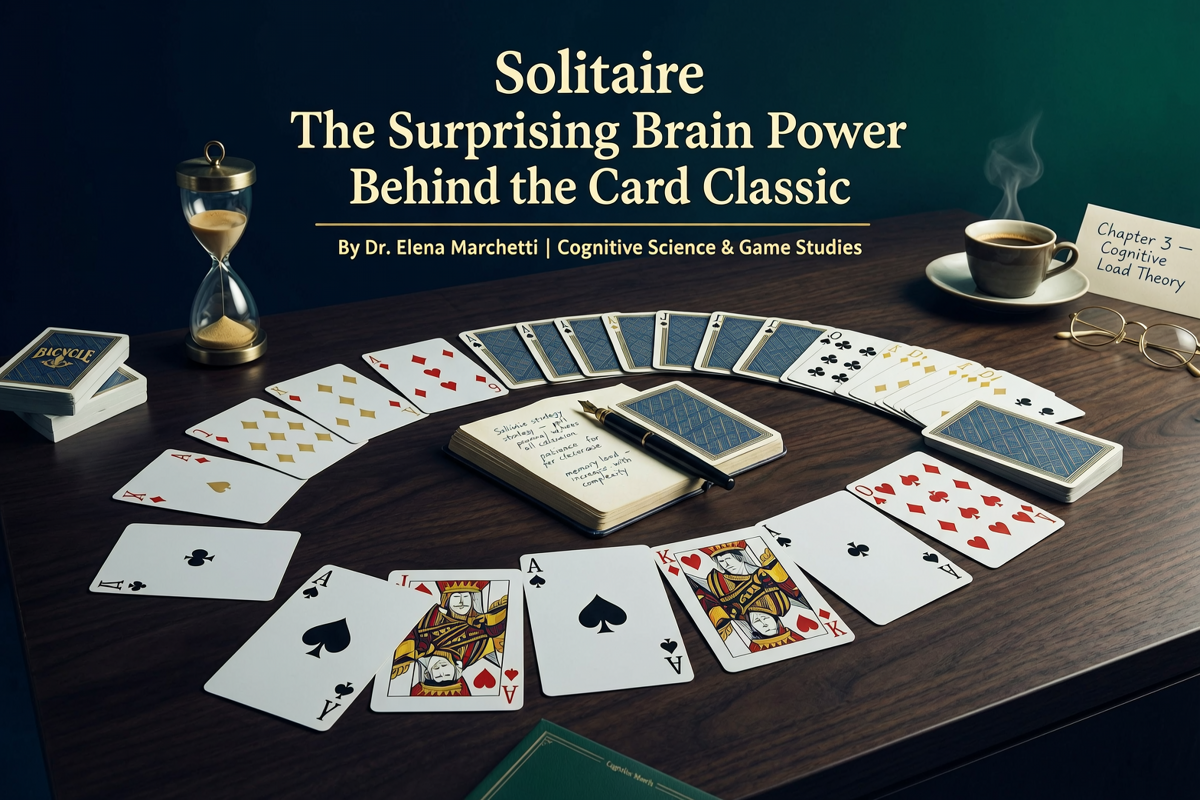
Solitaire: The Surprising Brain Power Behind the Card Classic
Solitaire is more than a time-waster: it sharpens memory, boosts problem-solving, calms anxiety, and provides a mindful escape. Explore its hidden powers.
The Quiet Genius of Solitaire
Mention solitaire, and most people picture the familiar green felt screen of a Windows desktop or a little card game on a smartphone during a commute. It is often dismissed as a way to kill time, a relic of pre-internet laziness. But if you look closer, solitaire is one of the most enduring and psychologically rich games ever created. It has survived centuries, crossed continents, and now thrives online as a daily habit for millions. More than just a way to pass the minutes, solitaire quietly exercises your brain, teaches you risk management, and even acts as a digital anchor for mindfulness in a chaotic world.
This article explores why solitaire deserves a place in your daily routine and how it can improve memory, focus, and emotional resilience. Whether you are a seasoned player or a curious newcomer, you will discover that this simple card game is far more than it appears.
A Brief History of Solitaire
Solitaire, also known as patience in Europe, dates back to the 18th century. It likely originated in Scandinavia or Germany as a way for aristocrats to sharpen their minds during long winters. The game's first known mention appears in a 1788 German game anthology, and it quickly became a fashionable pastime in France and England. By the 19th century, solitaire had evolved into hundreds of regional variations, each with its own rules and strategies.
The game's name itself is revealing. “Patience” was the original name, and it points to the core skill required: the ability to wait, plan, and accept unfavourable outcomes. The modern English term “solitaire” emphasizes the solitary nature of the play, but in its early days, it was often a social activity, with one player acting as the main strategist while others watched and offered advice. In the late 20th century, the game found a new home on personal computers. Microsoft bundled a digital version with Windows 3.0 in 1990, unwittingly introducing solitaire to a global audience and teaching a generation how to use a mouse along the way.
The Digital Revolution
The transition to digital radically changed solitaire. It was no longer necessary to shuffle, deal, and physically move cards. The computer handled the tedious parts, leaving players free to focus on decisions. This accessibility turned solitaire into one of the most played digital games in history. Today, online platforms offer hundreds of variations, daily challenges, stats tracking, and multiplayer modes, making the game more engaging than ever.
Why Solitaire Thrives Online
In an age of fast-paced battle royales and social media games, solitaire might seem like a quiet, almost quaint holdover. Yet it remains enormously popular. According to data from app stores, solitaire games consistently rank among the most downloaded casual games, with millions of active players each month. Why? The answer lies in its intrinsic design.
First, solitaire is endlessly replayable. A single deck of 52 cards creates an astronomical number of possible deals, so no two games are alike. Second, it demands just enough attention to distract you from stress but not so much that it adds to it. Third, online solitaire offers instant feedback and a built-in sense of progression through timers, win streaks, and achievements. These elements tap into the same reward loops that make video games addictive, but with a lower time commitment and a more relaxed pace.
A Game of Small Choices
Every move in solitaire is a micro-decision. Should you move that red five onto the black six, or save it? Is it wise to pull from the stock pile now, or do you have a better move beneath? These small choices train your brain to evaluate trade-offs quickly and strategically. Over time, players develop intuition for spotting hidden sequences and anticipating future dead ends. This is essentially problem-solving practice disguised as entertainment.
The Cognitive Benefits Hidden in the Cards
Scientific research on card games has long pointed to their benefits for mental acuity. Solitaire, in particular, engages multiple cognitive functions simultaneously:
- Working memory: You must remember which cards are where, which suits are blocked, and what you have already seen in the waste pile.
- Spatial reasoning: Arranging cards in a structured layout requires visual and spatial awareness, which strengthens your brain's ability to organize information.
- Planning and foresight: Successful solitaire play requires thinking several moves ahead, anticipating how the board will evolve.
- Flexibility: When a planned strategy fails, you must quickly adapt and find a new approach, improving cognitive flexibility.
A 2018 study published in the journals of gerontology found that older adults who played card games regularly showed better episodic memory and processing speed. Although the research was not exclusively about solitaire, it highlighted that card games in general are a low-cost, high-reward mental exercise. For younger players, solitaire can serve as a focal training tool, helping to build the patience and analytical thinking that academic and professional life demand.
Solitaire vs. Brain-Training Apps
Many commercial brain-training apps claim to improve memory and attention through repetitive mini-games. Solitaire offers a more organic and self-directed challenge. Instead of performing contrived tasks designed by a programmer, you face a realistic puzzle with clear rules and objectives. The game is inherently motivating because it ends in a satisfying visual symmetry: all cards stacked in suits, from ace to king.
Solitaire as Mindfulness and Stress Relief
Beyond cognition, solitaire has a powerful emotional dimension. Psychologists often recommend immersive activities as a way to enter a “flow” state, where you become fully absorbed in the present moment. Solitaire is perfect for this because it is structured, repetitive, and responsive. It offers a predictable world with a single focus, allowing your mind to temporarily set aside worries and intrusive thoughts.
This mindful quality explains why so many people play solitaire before bed or during a work break. The game's gentle rhythm of tapping and reorganizing cards reduces anxiety and lowers cortisol levels. Unlike social media, which can trigger comparison and fear of missing out, solitaire is a private, judgment-free space. You play only against the cards and yourself.
A Digital Anxiety Buffer
In a world full of notifications and interruptions, the simple act of completing a solitaire game gives a small but meaningful achievement. It reinforces your sense of agency. You can finish something, even if that something is just a card game. This can be especially helpful for people dealing with high stress, as it provides a healthy distraction and a reminder that progress is possible.
Popular Solitaire Variations Worth Trying
If you have only played Klondike, you are missing out on a rich variety. Here are a few classic versions that add fresh twists:
- FreeCell: Every card is dealt face-up, eliminating luck and turning the game into a pure test of logic.
- Spider Solitaire: Uses two decks and asks you to build sequences from king to ace within each suit, often requiring clever use of empty columns.
- Pyramid: A simple matching game where you remove cards that add up to 13, instead of building sequences.
- TriPeaks: A faster, more casual variant where you clear peaks of cards by choosing ones immediately higher or lower than the base card.
Each variation engages the brain differently. FreeCell is the darling of mathematicians and often used in studies on human problem-solving. Spider Solitaire demands deep planning and is beloved by advanced players. Trying multiple versions can keep the experience fresh and continuously stimulate your mental faculties.
How to Play with Purpose
To get the most out of solitaire, treat it as a mindful exercise rather than a mindless time-filler. Set a specific time of day for a few games, perhaps during a coffee break or after work. Before you start, take a deep breath and state an intention, such as “I will focus only on this game.” As you play, notice the patterns and try to verbalize your reasoning. For example, say to yourself, “I will move the black seven because that frees the queen.” This externalization reinforces logical thinking and makes you a more deliberate player.
If you find yourself getting frustrated by a losing streak, pause and remember the original name of the game: patience. Solitaire is not about winning every time; it is about enjoying the process of exploring possibilities. The best players lose gracefully and learn from each deal.
Striking the Right Balance
As with any game, moderation is key. Solitaire should be a supplement to your life, not a replacement for real-world interactions. Use it as a tool to sharpen your mind, calm your nerves, or simply reconnect with a classic form of entertainment. With thousands of online versions available for free, there has never been a better time to rediscover the humble card game that has quietly conquered the digital world.
Deal Your Next Game Today
Solitaire is more than a relic of pre-internet boredom. It is a strategic puzzle, a cognitive workout, and a portable sanctuary of patience. Whether you play on your phone, tablet, or computer, you are continuing a centuries-old tradition that spans cultures and generations. So the next time you see those familiar cards fan out on your screen, remember: you are not just wasting time. You are training your brain, soothing your mind, and mastering the gentle art of patience.